For SME owners
The board you needed at 2am.
Put a real decision in front of a board of AI directors. Finance, marketing, operations and strategy each argue it from their own corner, then the chair pulls the argument into a recommendation. For the calls you currently settle alone at the kitchen table.
Why a board
Four directors argue the same question
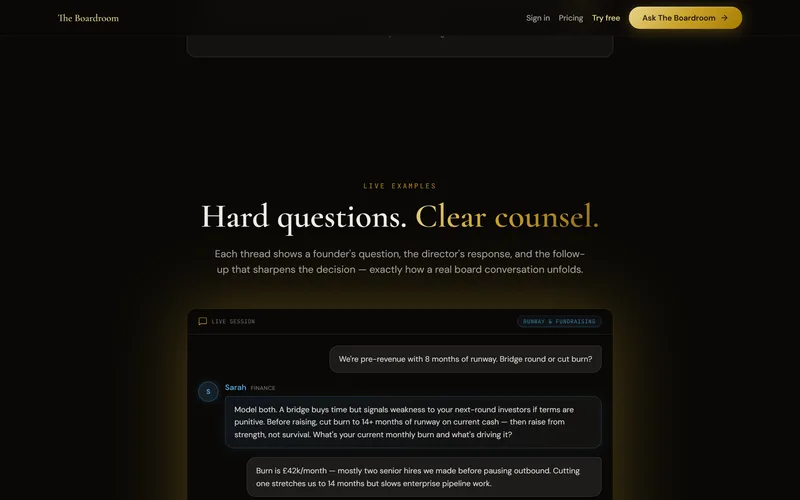
The Boardroom splits the question four ways. Finance, marketing, operations and strategy each argue from their own function, and the answers are allowed to disagree.
Finance looks at the margin. Marketing looks at how the price will be read. They answer the same question and they do not have to agree.
The Boardroom hands your question to finance, marketing, operations and strategy separately. Each argues its own corner and is allowed to be wrong about the others.
Where the directors split is where your decision actually lives. You see the split in full, then the chair takes a position. That is what a board is for.
What it sits on
Built for decisions with money on them
The decisions owner-managers actually lose sleep over: pricing, hiring, cash, premises and the next bet, usually without a committee attached.
Pricing
Raise them, restructure them, or hold while a competitor undercuts you.
The key hire
First salesperson or another pair of delivery hands. Full-time or contract. Now or after the next set of numbers.
Cash
The gap between invoiced and banked is widening. What moves first, and what can safely wait.
Premises
The bigger unit came up. The lease is long and the timing, as ever, is not obvious.
The growth bet
New service, new region, new market. Which one, and what you stop doing to fund it.
Every sitting ends the same way: the chair gives a recommendation and the reasoning that led there stays visible on the page. You can overrule the board. You just can't say nobody argued with you.
A board that sits whenever you ask
A full board on every question
Every question convenes the whole board, whether it is a pricing tweak or the biggest hire of your year. No picking which adviser to ask.
Directors with a corner to argue
Finance, marketing, operations and strategy each reason from their own function. Cash flow and brand positioning finally argue in the same room.
A chair who takes a position
The chair weighs the arguments and lands on a recommendation, with the reasons attached.
Decision history
Every sitting is kept. When the decision comes back around, you can reread who argued what and why you chose the way you did.
5 questions free
Put 5 real decisions to the board before paying anything, and judge it on whether the answers change what you do.
Monthly only, on purpose
£39 +VAT a month, no annual tier, cancel anytime. The price is on this page.
A board seat for £39 a month
Human peer boards cost roughly ten times as much and meet monthly, so your question waits for the next session. The Boardroom sits the moment you ask. £39/mo +VAT · monthly only, cancel anytime.
5 free questions to try the board
Questions about the board
How is this different from asking ChatGPT?
A single model blends every perspective it has ever read into one careful answer. The Boardroom runs your question through four separate directors, each reasoning from its own function with its own bias, then a chair who has to take a position. You see where they disagree instead of a smoothed-over average, and the disagreement is usually the useful part.
Who is it for?
Owner-managers of SMEs who make significant decisions without a leadership team to test them on. If you have ever priced a job, chosen a hire or signed a lease with nobody to argue against you, it is for you.
What is the BusinessGrowthFormula connection?
Boardroom is part of the Capstone portfolio, run with our partners at BusinessGrowthFormula. The app lives at boardroom.businessgrowthformula.org, which is where every button on this page takes you. Same product, same board, either way in.
How does the trial work?
5 free questions. Each one convenes the full board: four director takes plus the chair’s recommendation, exactly what paying members get. Spend them on real decisions rather than test prompts; the board is at its best with money on the table.
Is there a contract?
No. £39 +VAT a month, monthly only, cancel anytime. There is deliberately no annual plan. A board should have to keep earning its seat.
Watch four directors disagree
One question, four functional views, then a chair who lands a recommendation.
Put a real decision to the board
Your next hard call is probably already sitting in your head. Ask it. 5 questions free, then £39 +VAT a month, monthly only, cancel anytime.