For UK accountants
UK tax answers you can cite.
Ask a UK tax question. Athena answers from HMRC, GOV.UK and legislation, with checked citations and a confidence score. And when the guidance does not cover it, she says so instead of making something up.
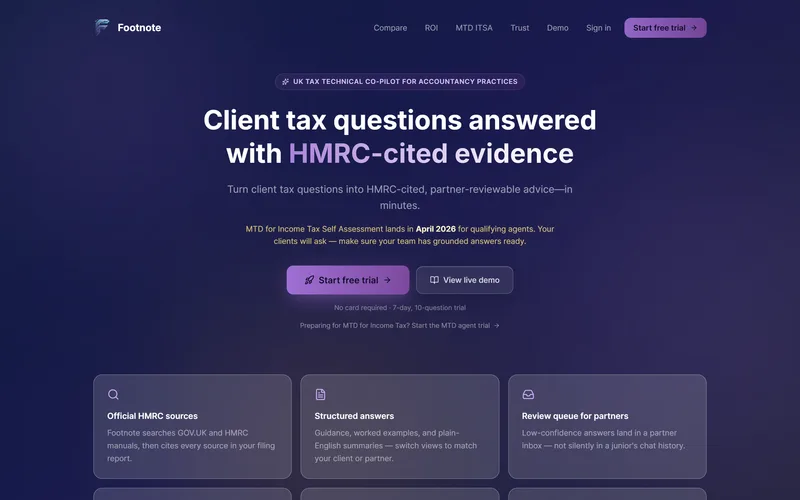
Footnote only says what the guidance will back
Three things happen to every answer before you see it.
Answers are built only from HMRC manuals, GOV.UK and legislation.gov.uk.
Each answer carries a confidence score based on how directly the guidance covers your facts. You see the number before you rely on the words.
Below the threshold, Athena declines and tells you why, so you know the question needs a person before you rely on the words.
Research that holds up in the file
Citations, checked and linked
Every answer carries the HMRC and GOV.UK paragraphs it stands on. Click through, verify, drop the PDF in the client file.
Confidence scores you can act on
A 96% answer and a 71% answer get treated differently, and Footnote tells you which one you have. Below the threshold it refuses outright.
Built for the MTD surge
Around 780,000 newly mandated taxpayers are in MTD ITSA. Their questions are now your inbox.
Reports worth filing
Client-ready PDF exports with tamper-evident public verification, so the advice you give keeps its provenance long after the meeting.
Guidance-change alerts
When HMRC moves the goalposts under an answer you have already relied on, Footnote flags it instead of leaving you to find out in an enquiry.
A partner review queue
Low-confidence answers can route to a second pair of eyes inside the practice. The evidence gate has a human layer when you want one.
Footnote prices
Between the £5,000-a-year research lock-ins and an AI you can't trust, there is this: Solo £39 · Practice £59 · Enterprise £199 /mo +VAT. Monthly, cancel anytime. 2 months free paid annually.
7-day / 10-question free trial. No card
Footnote and the rest of the suite
Footnote answers the question. Envelope decodes the letter that prompted it, Engage wins the client who asked, AccountFlow runs the practice around them, and Narrative tells their story in the management accounts. Same evidence gate everywhere.
Questions about Footnote
What sources does Footnote cite?
HMRC manuals, GOV.UK guidance and legislation.gov.uk. Every answer links the exact paragraphs it relied on, and citations are checked before the answer reaches you.
What happens when the guidance is thin?
Athena refuses to answer rather than guess, and low-confidence answers can route to a partner review queue. A refusal tells you the question needs a human, which is worth knowing before you bill the hour.
Does the AI do the maths?
No. Calculations such as CGT, salary versus dividend and HICBC run through deterministic code that is tested against a golden suite. The model explains; it never arithmetics its way into your client file.
How does the free trial work?
Seven days, ten questions, no card. If it does not earn a place in your workflow by question ten, walk away and pay nothing.
Is there a contract?
Monthly, cancel anytime. The price is on this page, which is more than the incumbents will show you without a sales call.
Watch a question earn its stamp
A question goes in, the sources get searched, the answer arrives cited and scored. This is the whole product in one loop.
Ten questions, on the house
Seven days, ten real questions from your desk, no card. If Footnote can't cite its way into your workflow, it doesn't deserve the seat.